
Home / Aluminum Patio Covers
Shade that won’t rot, warp or need paint. Quality First Patios designs and builds aluminum patio covers in Southern California, from solid and insulated roofs to lattice and louvered covers.
Tell us where you are. We reply within 24 hours.
We’ll only contact you about your project.
Reviews from Southern California homeowners we have built for.
★★★★★
“Paste real review #1 here.”
Customer name, City via Google
★★★★★
“Paste real review #2 here.”
Customer name, City via Google
★★★★★
“Paste real review #3 here.”
Customer name, City via Google
An aluminum patio cover is a roof over your patio made of powder-coated aluminum beams, posts and panels, usually attached to the house. It gives shade and, with a solid roof, rain protection, and unlike wood it does not rot, warp or attract termites.
That is why aluminum patio covers are the most common choice in Southern California. They handle triple-digit inland heat, coastal salt air and winter storms, and the factory finish never needs paint or stain. Many come in a wood-grain finish, so they look like wood without the upkeep.
Quality First Patios designs and builds aluminum patio covers with Duralum aluminum from our base in San Jacinto. Since 2022 our crew has built more than 100 patio covers across Riverside, San Bernardino, Los Angeles, Orange and San Diego counties. We pull the permit, handle HOA paperwork, and every project starts with a free visit to your home.
Written by Quality First Patios, licensed patio cover contractor, CA Lic #1138842 (verify on CSLB). Reviewed by [CONFIRM: owner name]. Updated October 2026.
Heat, storms, wind and paperwork are the reasons most of our customers call. Here is how an aluminum patio cover deals with each one.
Patios in the Inland Empire and Coachella Valley bake in full sun every summer afternoon.
How an aluminum cover helpsAn insulated aluminum roof keeps the patio far cooler than open sun, and a ceiling fan keeps air moving.
Winter storms drop a lot of rain in a short time and leave bare patios flooded.
How an aluminum cover helpsSolid aluminum roofs shed water to the front edge, and built-in gutters carry it off the patio.
Fall and winter Santa Ana gusts put real force on anything built outdoors.
How an aluminum cover helpsWe engineer every aluminum cover to wind codes up to 130 mph and size the posts and footings for your yard.
Old wood patio covers split, sag and attract termites over time.
How an aluminum cover helpsAluminum can’t rot or feed termites, and its baked-on finish never needs painting.
Year-round SoCal sun bleaches cushions, decking and floors near your back door.
How an aluminum cover helpsShade from an aluminum cover protects cushions, decking and the rooms behind your back door.
Most cities want a permit for an attached cover, and many HOAs want to review the design.
How an aluminum cover helpsWe draw the plans, pull the permit and prepare your HOA submittal, so the paperwork is off your plate.
There are six main types of aluminum patio covers: solid, insulated, non-insulated, lattice, louvered and custom combinations. Solid and insulated covers give full shade and keep rain off, lattice filters the sun, and louvered covers let you open and close the roof.
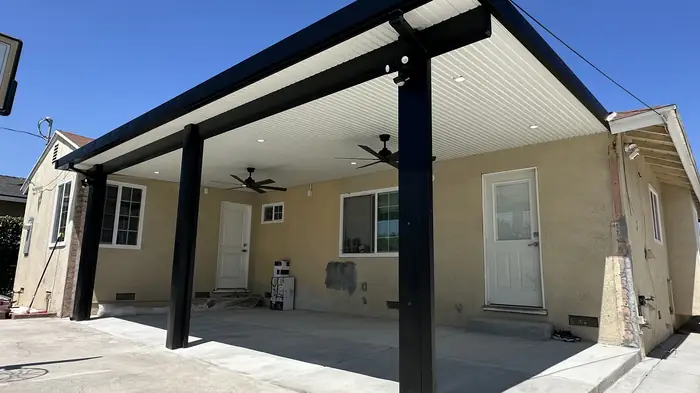
Full shade and rain protection with a closed aluminum roof.
from $14.50/sq ft
Learn more →
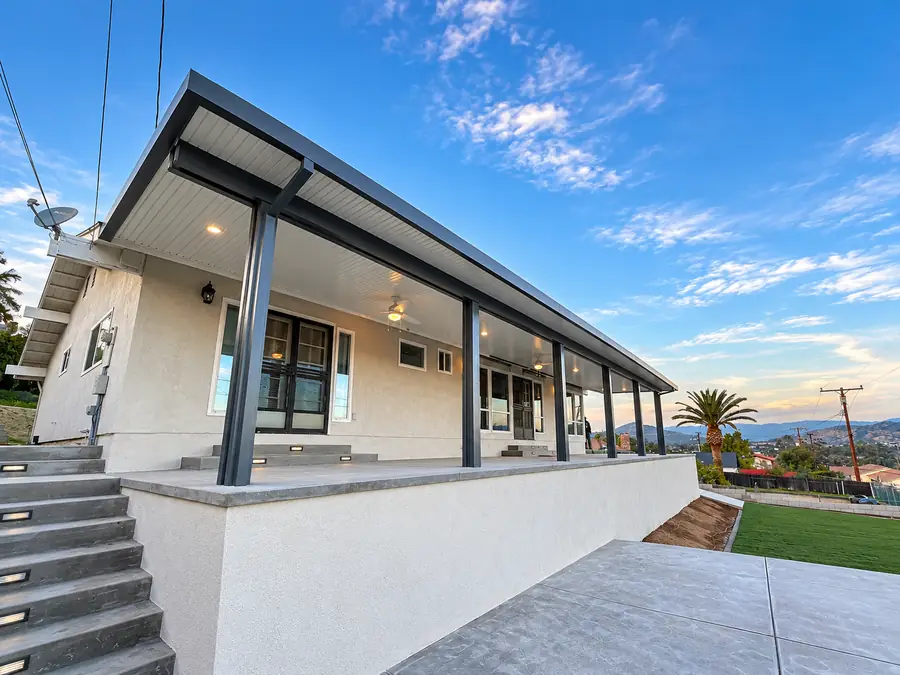
Foam-core roof that blocks far more heat and softens rain noise.
from $20/sq ft
Learn more →
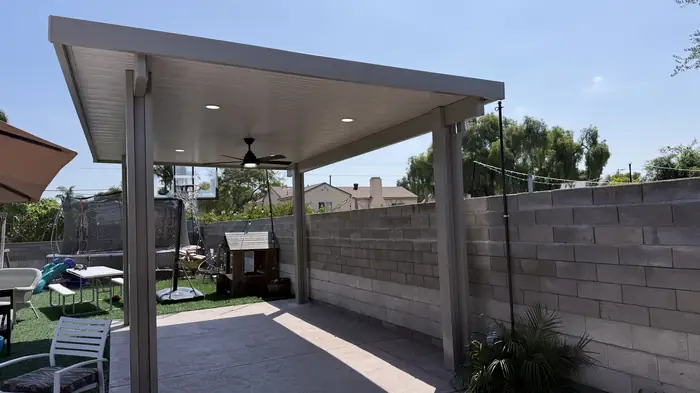
Single-layer solid roof: full shade for a lower price.
from $14.50/sq ft
Learn more →
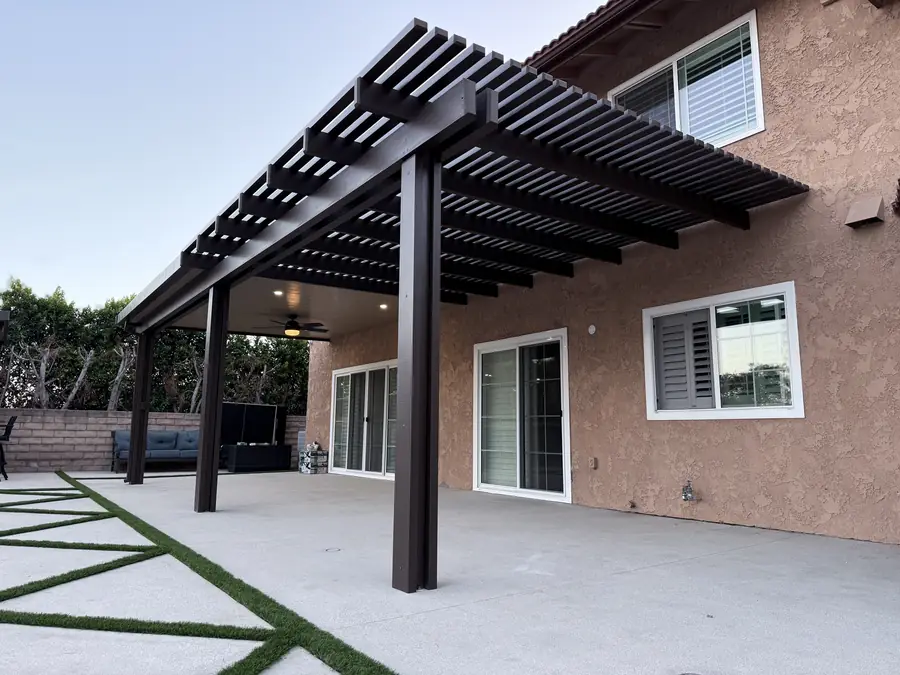
Open rafters filter the sun and keep the house bright.
Priced at home visit
Learn more →
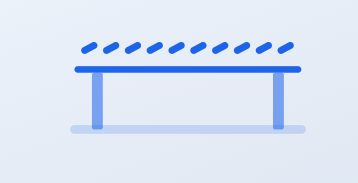
Slats you open for sun or close for shade and rain.
Priced at home visit
Learn more →
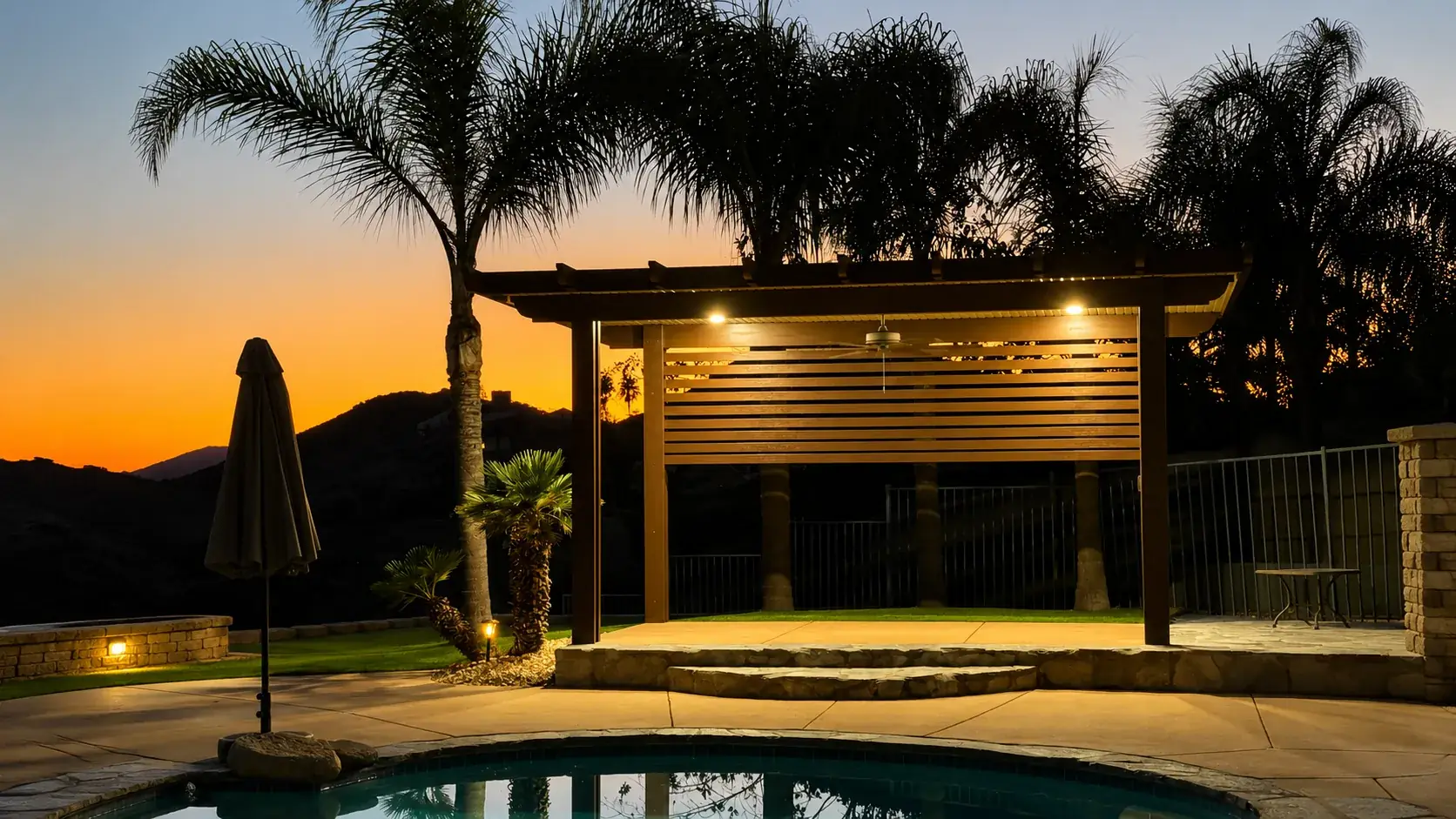
Combos, gables, privacy walls, lights and fans, built around your home.
Priced at home visit
Learn more →
CoastSan Diego, Irvine, Newport Beach
InlandRiverside, Hemet, Palm Springs
Southern California backyards are not all the same. In Hemet, Menifee, Riverside, Palm Springs or anywhere in the Inland Empire and Coachella Valley with triple-digit summers, an insulated aluminum patio cover usually does the most for comfort: the foam core blocks far more heat than a single panel, and it is quieter in the rain.
Near the coast, where the concern is glare and the odd winter storm rather than raw heat, a non-insulated or lattice patio cover often gives you everything you need for less. If you want sun some days and shade on others, a louvered cover lets you choose.
Choose a solid or insulated aluminum patio cover if you want full shade and a dry patio; insulated is the cooler and quieter of the two. Choose lattice for filtered light and a brighter house, or louvered if you want to open the roof on nice days and close it when it rains.
Swipe to compare all four →

Single aluminum panel

Foam-core panel
Open rafters
Adjustable slats
Shade
Full
Full
Partial
Adjustable
Keeps rain off
✓ Yes
✓ Yes
✕ No
✓ When closed
Blocks heat
Good
Best
Some
Good when closed
Rain noise
Louder
Quiet
None
Some
Starting price
$$$Mid
$$$Highest
$$$Lowest
$$$Highest
Want two at once? A combo cover puts a solid roof where you sit and an open lattice section where you want sun. See custom patio covers.
How much do aluminum patio covers cost in Southern California? Our aluminum patio covers start at $14.50 per square foot for a solid non-insulated roof and $20 per square foot for an insulated roof, measured on a 20×20 cover. A 12×20 solid cover starts at $4,440. Lattice, louvered and custom covers get an exact price after a free home visit.
1. Choose a style
2. Choose a size
Insulated aluminum patio cover, 12x20
$6,000
from $25 per sq ft · 240 sq ft
Starting price for a standard attached cover on an existing slab.
Get my exact priceStyle
Starting price
Good to know
from $14.50/sq ft$4,440 for 12×20
Lowest price with full rain protection
from $20/sq ft$6,000 for 12×20
Coolest and quietest roof
Quote after home visit[CONFIRM: starting price]
Less roof material than a solid cover
Quote after home visit[CONFIRM: starting price]
Moving slats make it the premium option
Quote after home visit
Priced from your design
Share your city and what you have in mind. Within 24 hours we set up a home visit, show you styles that fit your yard, and send a written quote. No pressure, no obligation.
We’ll only contact you about your project.
Real Quality First Patios projects. No stock photos.
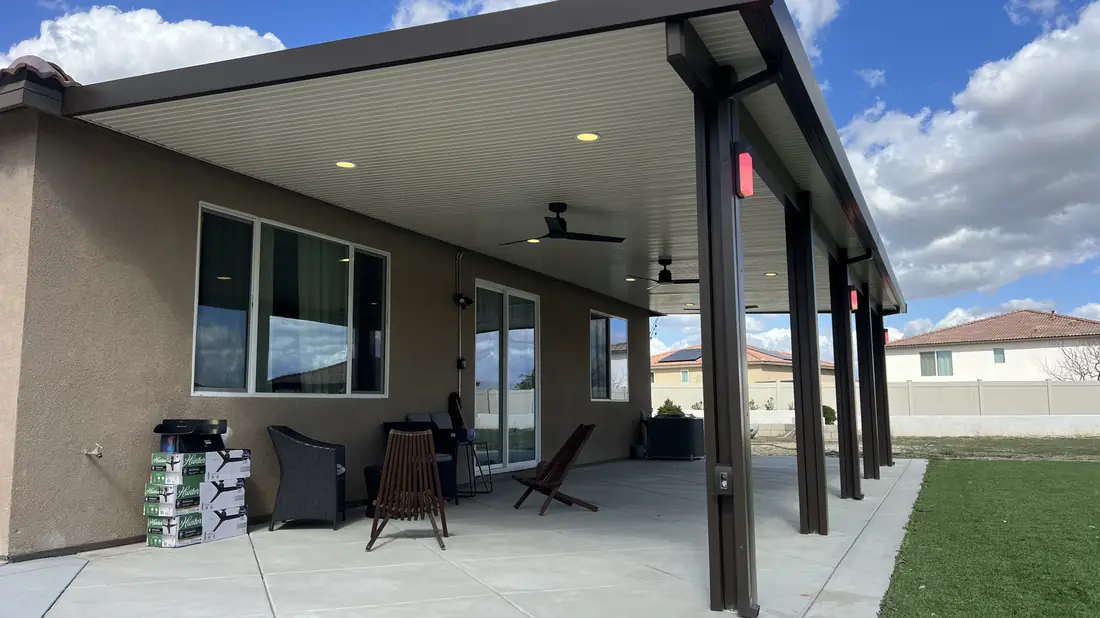
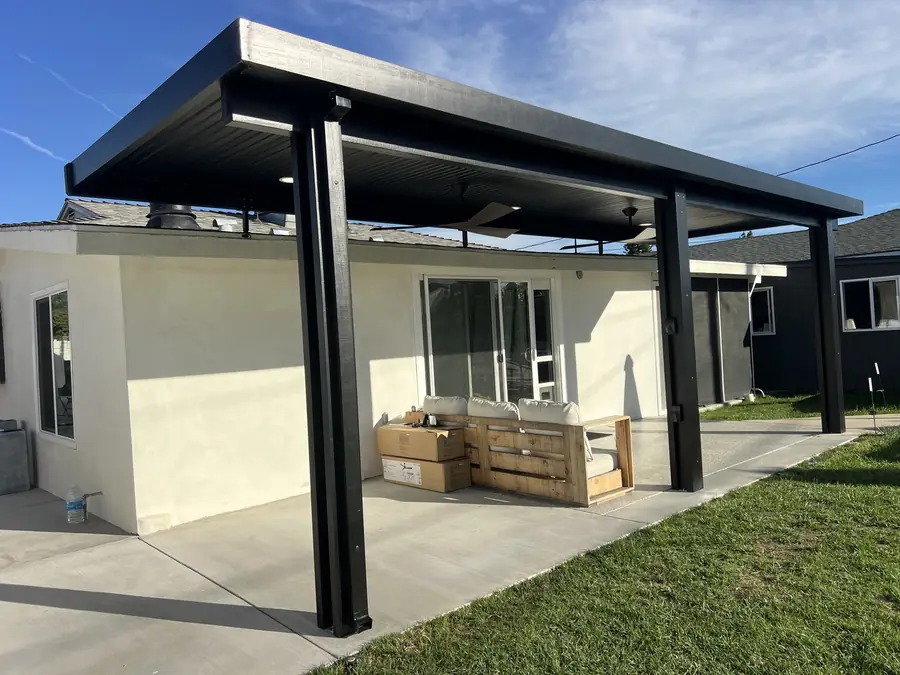
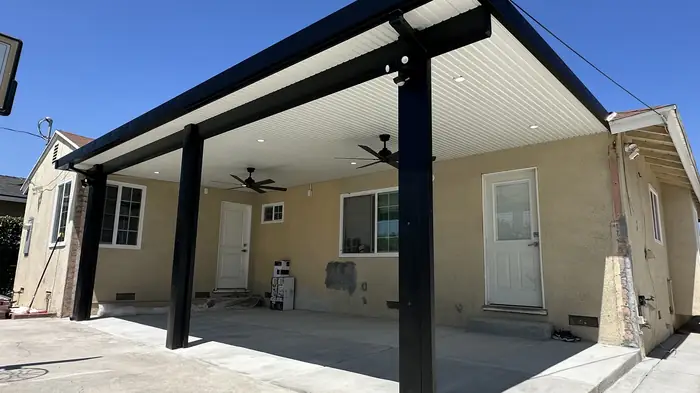
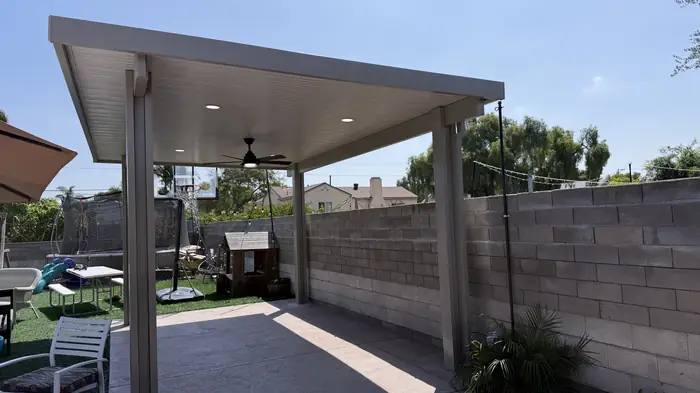
Real Quality First Patios projects. No stock photos.

From first call to final inspection.
Tell us your city and what you have in mind. We reply within 24 hours.
We measure the patio, look at how the cover can attach, and show you styles, colors and options.
One clear price for the cover you chose, with the permit fee shown on its own line.
We prepare the plans and pull the permit with your city or county, and handle HOA paperwork. Do I need one?
Our crew sets the posts, beams and roof, adds gutters and any wiring. Most covers take 1–2 days.
The inspector signs off, and we walk you through your new cover.
A short look at our crew building an aluminum patio cover, from the first post to the final walkthrough.
Your aluminum patio cover is built to order. Pick the beam ends, the finish color and the post style, then add lighting and fans for evenings outside.
The cut on the end of each rafter. Keep a straight look, or pick one of four cut ends.
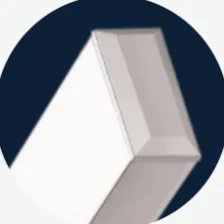
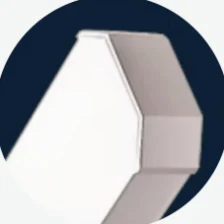
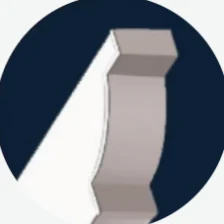

Duralum wood-grain colors with a factory DuraTough Coating™ finish, so there is nothing to paint. Also available in Ebony/Black.
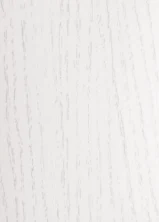
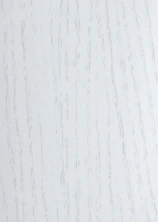
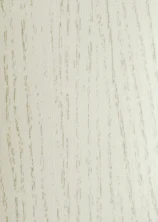
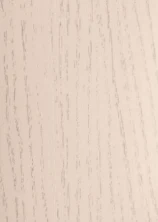
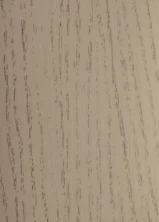
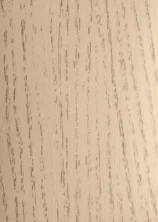
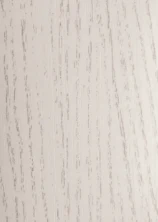
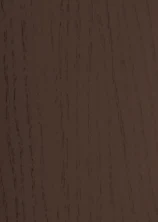
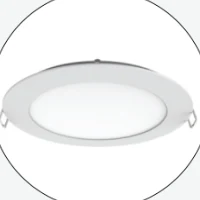
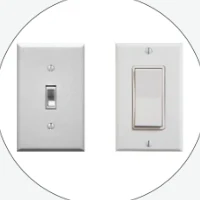
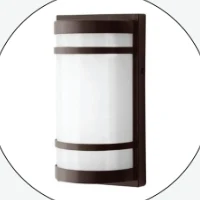
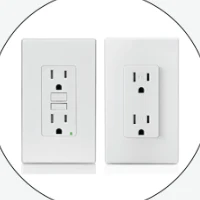
Lights, fans and power under the cover, installed by our crew. Each item is quoted separately.

What holds the cover up. All three are engineered for the same wind and seismic codes.
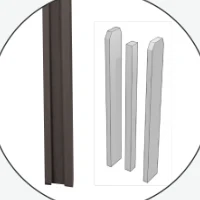
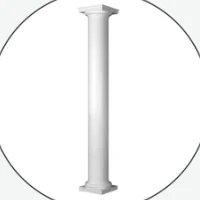
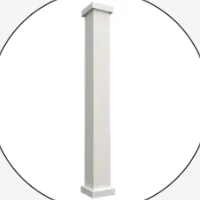
Want light in one spot? A solid roof can have a lattice section where you want it. See custom patio covers.
Most Southern California cities and counties require a building permit for an attached aluminum patio cover. The permit comes from your city, or from the county if you live in an unincorporated area. We check the rules for your address, prepare the plans and pull the permit for every cover we build.
County
Who issues the permit
What we handle
Riverside County
Your city building department, or Riverside County Building & Safety (county patio cover handout)
Plans, permit, inspections
San Bernardino County
Your city building department, or the county Building & Safety division
Plans, permit, inspections
Los Angeles County
Your city building department, or LA County Public Works Building & Safety
Plans, permit, inspections
Orange County
Your city building department, or OC Public Works for unincorporated areas
Plans, permit, inspections
San Diego County
Your city building department (City of San Diego patio cover bulletin), or County Planning & Development Services
Plans, permit, inspections
If you live in an HOA, we also prepare the drawings, color and style details your architectural committee asks for. See Do I need a permit?
Most Southern California homeowners choose aluminum over wood for one reason: upkeep. Here is the short version:
| Aluminum | Wood | |
|---|---|---|
| Rot & termites | Won’t rot, no termites | Can rot and attract termites |
| Upkeep | Rinse with a hose | Regular sealing or painting |
| Sun | Won’t warp | Can warp and crack |
| Look | Wood-grain or smooth finish | Natural wood |
| Price | Usually lower | Usually higher |
An attached aluminum patio cover connects to your house on one side and sits on posts at the front. Most homeowners pick this because it shades the space just outside the back door. A freestanding cover stands on its own posts, so it works by the pool, at the back of the yard, or where the house wall can’t take the load.
What helpsWe install all four mountings: wall, fascia, roof-mount and freestanding. See custom patio covers.
A solid roof lets less daylight reach the rooms behind it, especially if the cover is deep and low.
What helpsA higher mounting, a lighter color, or a lattice section in front of your windows keeps the house brighter.
Lights and fans are easiest to add while the cover is being built, because the wiring runs inside the beams. Enclosing a cover later turns it into a room addition, which needs its own permit and different construction.
What helpsTell us at the home visit if you might want lights or fans, so we plan the wiring from the start.
From our base in San Jacinto, our crew builds across 132 cities in five Southern California counties.
cities
counties
local crew
Start typing to check your city.
City page with local info
Straight answers to the questions Southern California homeowners ask us most.
Our solid aluminum patio covers start at $14.50 per square foot with a non-insulated roof and $20 per square foot with an insulated roof, on a 20×20 cover. Per-square-foot prices drop as covers get bigger, since setup costs stay about the same. Lattice, louvered and custom covers are quoted after a free home visit.
A non-insulated solid roof is usually the lowest-cost aluminum patio cover that still keeps rain off, starting at $14.50 per square foot on a large cover. Lattice covers can also cost less because they use less roof material. Insulated and louvered covers cost the most.
For our solid roof covers it ranges from about $14.50 to $28 per square foot non-insulated and $20 to $38 insulated, depending on size. Extras such as lighting, fans, new footings and permit fees are added on their own lines.
Usually, yes. Most Southern California cities require a building permit for an attached patio cover, and some also require one for larger freestanding covers. Setback, height and HOA rules apply either way. We check the rules for your address and pull the permit for every cover we build.
Many Southern California HOAs require architectural approval before a patio cover goes up. Most approve aluminum covers when the color and style match the house. We prepare the drawings and details your HOA asks for.
In hot inland areas like the Inland Empire and the Coachella Valley, an insulated solid aluminum patio cover keeps the space coolest, because its foam core blocks far more heat than a single panel. Near the coast, a non-insulated or lattice cover is often enough.
An insulated cover has a foam core between two aluminum skins, so it blocks much more heat and is quieter in the rain, but it costs more. A non-insulated cover is a single aluminum panel that gives full shade and rain protection for less. Insulated suits inland heat; non-insulated suits coastal and shaded yards.
A single-layer aluminum roof can warm up in strong afternoon sun, though the shade underneath is still much cooler than open sun. An insulated aluminum roof stays far cooler, and a ceiling fan under the cover helps move the air.
Rain is louder on a single-layer aluminum roof. Insulated panels are much quieter because the foam core softens the sound.
With normal care, an aluminum patio cover lasts for decades. The metal won't rot, split or feed termites, and Duralum backs the finish with a lifetime warranty that stays with the house if you sell.
A permitted, well-built patio cover adds usable outdoor living space, which many buyers look for in Southern California. How much value it adds depends on your home and market. A permit matters, because unpermitted structures can cause problems when you sell.
Alumawood is a brand name for wood-grain aluminum patio covers, and many people use it for any aluminum cover that looks like wood. We build with Duralum Weatherwood, a comparable wood-grain aluminum line with a factory DuraTough Coating finish.
Every cover we build uses Duralum aluminum. Duralum has manufactured patio covers in the USA since 1962, and its Weatherwood® lines come in solid, insulated and lattice styles.
The Duralum warranty covers defects in materials, workmanship and the factory finish, which is guaranteed not to peel, flake, blister or chip in normal weather for the life of the cover. Insulated panels have a 20-year limited warranty. Coverage passes to the next owner and requires a properly engineered, permitted installation.
Most of our aluminum patio covers go up in 1 to 2 days once the permit is approved. Large, freestanding and custom designs can take a few days more. Getting the permit usually takes longer than the build itself.
Yes. Most aluminum patio covers are attached to the house wall, fascia or roof and sit on posts at the front. The connection is fastened into the house framing and flashed so water can't get behind it. Freestanding covers stand on their own posts.
Only basic cleaning. A few times a year, hose off the roof, empty the gutters and wipe the posts with mild soap. You never need to paint, stain or seal the factory finish.
Yes. We can add recessed LED lights, ceiling fans, switches and outlets while we build the cover, with the wiring hidden inside the beams. The electrical work is inspected as part of the permit.
Under California law, a home improvement down payment can't be more than $1,000 or 10% of the contract price, whichever is less. Our contracts follow that limit and list every payment before work begins.
Yes. Financing options are available, and we can walk you through them at your free in-home estimate.
Our solid aluminum patio covers start at $14.50 per square foot with a non-insulated roof and $20 per square foot with an insulated roof, on a 20×20 cover. Per-square-foot prices drop as covers get bigger, since setup costs stay about the same. Lattice, louvered and custom covers are quoted after a free home visit.
A non-insulated solid roof is usually the lowest-cost aluminum patio cover that still keeps rain off, starting at $14.50 per square foot on a large cover. Lattice covers can also cost less because they use less roof material. Insulated and louvered covers cost the most.
For our solid roof covers it ranges from about $14.50 to $28 per square foot non-insulated and $20 to $38 insulated, depending on size. Extras such as lighting, fans, new footings and permit fees are added on their own lines.
Under California law, a home improvement down payment can't be more than $1,000 or 10% of the contract price, whichever is less. Our contracts follow that limit and list every payment before work begins.
Yes. Financing options are available, and we can walk you through them at your free in-home estimate.
Usually, yes. Most Southern California cities require a building permit for an attached patio cover, and some also require one for larger freestanding covers. Setback, height and HOA rules apply either way. We check the rules for your address and pull the permit for every cover we build.
Many Southern California HOAs require architectural approval before a patio cover goes up. Most approve aluminum covers when the color and style match the house. We prepare the drawings and details your HOA asks for.
In hot inland areas like the Inland Empire and the Coachella Valley, an insulated solid aluminum patio cover keeps the space coolest, because its foam core blocks far more heat than a single panel. Near the coast, a non-insulated or lattice cover is often enough.
An insulated cover has a foam core between two aluminum skins, so it blocks much more heat and is quieter in the rain, but it costs more. A non-insulated cover is a single aluminum panel that gives full shade and rain protection for less. Insulated suits inland heat; non-insulated suits coastal and shaded yards.
A single-layer aluminum roof can warm up in strong afternoon sun, though the shade underneath is still much cooler than open sun. An insulated aluminum roof stays far cooler, and a ceiling fan under the cover helps move the air.
Rain is louder on a single-layer aluminum roof. Insulated panels are much quieter because the foam core softens the sound.
With normal care, an aluminum patio cover lasts for decades. The metal won't rot, split or feed termites, and Duralum backs the finish with a lifetime warranty that stays with the house if you sell.
A permitted, well-built patio cover adds usable outdoor living space, which many buyers look for in Southern California. How much value it adds depends on your home and market. A permit matters, because unpermitted structures can cause problems when you sell.
Alumawood is a brand name for wood-grain aluminum patio covers, and many people use it for any aluminum cover that looks like wood. We build with Duralum Weatherwood, a comparable wood-grain aluminum line with a factory DuraTough Coating finish.
Every cover we build uses Duralum aluminum. Duralum has manufactured patio covers in the USA since 1962, and its Weatherwood® lines come in solid, insulated and lattice styles.
The Duralum warranty covers defects in materials, workmanship and the factory finish, which is guaranteed not to peel, flake, blister or chip in normal weather for the life of the cover. Insulated panels have a 20-year limited warranty. Coverage passes to the next owner and requires a properly engineered, permitted installation.
Only basic cleaning. A few times a year, hose off the roof, empty the gutters and wipe the posts with mild soap. You never need to paint, stain or seal the factory finish.
Most of our aluminum patio covers go up in 1 to 2 days once the permit is approved. Large, freestanding and custom designs can take a few days more. Getting the permit usually takes longer than the build itself.
Yes. Most aluminum patio covers are attached to the house wall, fascia or roof and sit on posts at the front. The connection is fastened into the house framing and flashed so water can't get behind it. Freestanding covers stand on their own posts.
Yes. We can add recessed LED lights, ceiling fans, switches and outlets while we build the cover, with the wiring hidden inside the beams. The electrical work is inspected as part of the permit.
Call us at (888) 341-6941 or ask during your free home visit.
Send us your city and a rough patio size. We’ll book a free home visit, help you choose the right style for your backyard, and give you a written quote.
Quality First Patios1677 Constant Trails, San Jacinto, CA 92582